
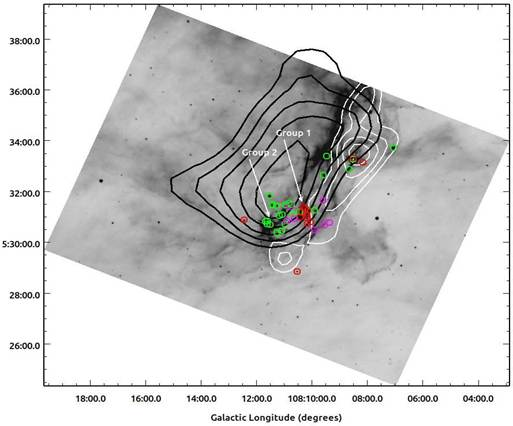
Molecular clouds, often described as stellar nurseries, are vast regions composed mainly of hydrogen gas and cosmic dust where stars are born. Researchers observed that the presence of massive stars significantly alters the physical conditions within these clouds. The intense ultraviolet radiation emitted by these stellar giants heats and compresses nearby gas in some regions, triggering the collapse of dense pockets that eventually form new stars. At the same time, the strong winds and shockwaves generated by these stars can disperse gas in other regions, effectively halting further star formation.
Scientists noted that this balancing effect acts as a natural regulatory mechanism controlling the pace of star formation within the molecular cloud. The findings suggest that massive stars do not merely emerge from stellar nurseries but actively reshape and influence the future evolution of their environments. Such stellar feedback is believed to play a major role in determining the structure, temperature and density of molecular clouds over millions of years.
The research was carried out using high-resolution observations from advanced astronomical instruments capable of tracing the movement and distribution of gas and dust across the cloud. By analysing different wavelengths of light, astronomers were able to map regions where star formation is actively occurring and identify areas where stellar feedback has disrupted the process.
About the Author